Last Updated: November 4, 2026
Quick Summary
A whole home battery stores electricity in a lithium-ion bank paired with an inverter and transfer switch, so your home runs on stored power during outages or peak utility rates. It runs silently, needs no fuel, and switches over almost seamlessly to keep essential appliances and electronics running during an outage.
- Depending on its capacity and configuration, a battery backup system can supply selected essential circuits or your entire home.
- Size capacity from a load list of running and surge watts, not from square footage or solar array size.
- Check both continuous and peak output ratings, since low kW output trips when a compressor or well pump starts.
- Send us photos of your electrical panel and equipment model numbers so we can review compatibility and discuss backup power options.
Table of Contents
- How Whole Home Battery Backup Systems Work
- Whole House Battery Backup vs Generator
- Solar Battery Backup Capacity Requirements
- Request a Whole Home Battery Backup Assessment
- Frequently Asked Questions
How Whole Home Battery Backup Systems Work
The benefits of whole home battery backup start with one simple idea: stored electricity you control. A whole home battery system pairs a lithium-ion battery bank with an inverter and a transfer switch, so your home can run on stored power when the grid goes down or when utility rates peak.
Depending on its capacity and configuration, a battery backup system can supply selected essential circuits or your entire home. During an outage, the system supplies a set of circuits backed up at installation, often called critical loads, a design decision, not a default.
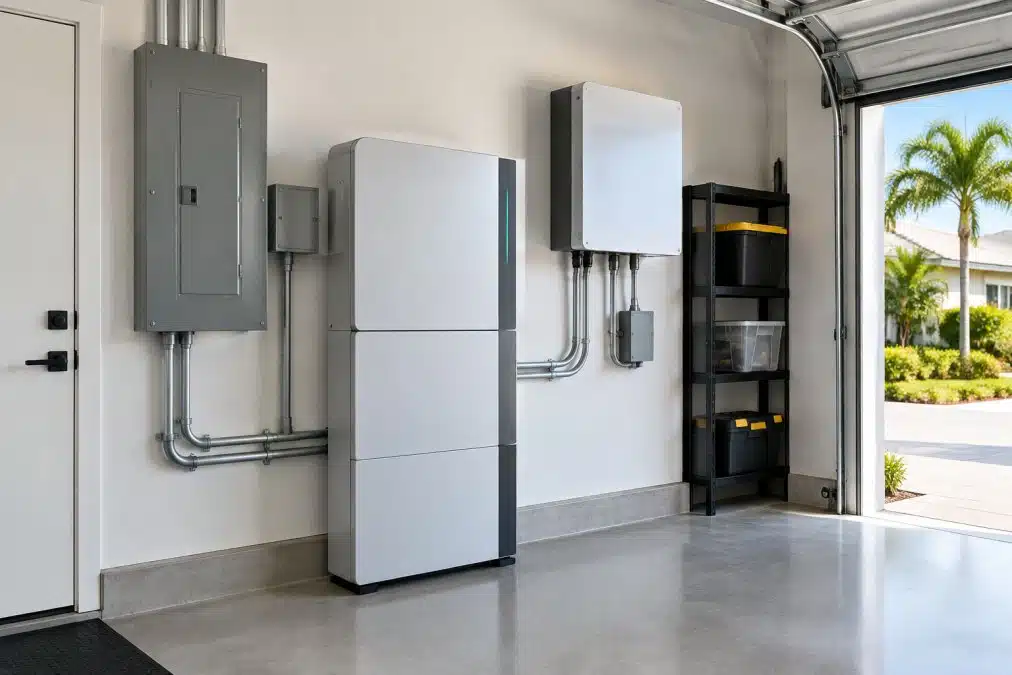
To see the systems we install and what the process involves, review our battery backup systems in Riverview, FL.
Whole House Battery Backup vs Generator
The whole house battery backup vs generator question comes down to fuel, noise, and how long you need to ride out an outage. A battery runs silently, needs no fuel delivery, and switches over fast enough to keep clocks, routers, and medical devices alive. A standby generator can run for days on stored fuel, but it is louder, needs regular maintenance, and depends on fuel arriving.
- Transfer time. A battery inverter transitions almost seamlessly, so electronics stay on. A standby generator starts, stabilizes, then transfers, enough delay to reboot computers and reset clocks.
- Fuel dependency. A battery recharges from solar or the grid, so its runtime is dependent on a properly sized solar array. A generator’s runtime is limited by fuel storage and delivery.
- Load management. A battery system can be programmed to shed non-essential loads automatically, stretching runtime. A generator sized for the whole house runs everything at once, meaning a larger, more expensive unit and more fuel burn.
- Maintenance. A battery has no oil changes, no fuel filters, and no exercise schedule. A standby generator needs periodic exercise and servicing to stay reliable.
- Noise and placement. A battery is essentially silent and can often be wall-mounted in a garage. A generator needs outdoor placement, clearances, and permits, and it is audible to neighbors.
A battery can suit both short, frequent outages or long term outages for homes that want quiet, maintenance-free backup. A generator suits long storm-related outages where fuel can be stored on site. Some homes use both. Our generator installation in Riverview, FL page covers transfer switches and standby setups.
Watch out: a generator that is undersized for your surge loads will trip when the AC or well pump starts, and a battery that is undersized for your runtime goal will drain before the outage ends. The fix in both cases is the same, build the load list first, then size the equipment to it.
Here is how a battery and a standby generator compare on the factors that matter most during an outage.
|
Factor |
Battery |
Standby generator |
|---|---|---|
|
Transfer time |
Almost seamless; electronics stay on |
Starts, stabilizes, then transfers; clocks reset |
|
Fuel dependency |
Recharges from solar or grid; runtime dependent on solar array size |
Runtime limited by fuel storage and delivery |
|
Load management |
Can shed non-essential loads automatically |
Sized for whole house; larger unit, more fuel |
|
Maintenance |
No oil changes, fuel filters, or exercise |
Needs periodic exercise and servicing |
|
Noise and placement |
Essentially silent; often wall-mounted in garage |
Outdoor placement, clearances, permits; audible |
|
Best for |
Short, or extended outages; quiet, low-maintenance backup |
Long storm outages with fuel stored on site |
Solar Battery Backup Capacity Requirements
Solar battery backup capacity requirements are about matching battery size to what you actually want to run, not to the size of your solar array. Capacity is measured in kilowatt-hours (kWh), and usable capacity is lower than nameplate because batteries limit their depth of discharge (DoD) to protect longevity. Round-trip efficiency also matters, so a 10 kWh battery may deliver closer to 9 kWh of usable power after losses and DoD limits.
Sizing starts with a load list, not a square-footage rule. Note what you want to keep running during an outage: refrigerator, freezer, a few lights, internet router, phone chargers, medical equipment, and maybe a well pump or a single AC zone. Add up the running watts and the surge watts (motors and compressors draw a burst of power at startup), then multiply by the hours you want to cover. The right capacity depends on your load list, and an assessment is the best way to size it.
Continuous output matters as much as capacity. A battery with plenty of kWh but a low continuous kW rating will trip when a compressor or well pump kicks on. Check both the continuous and peak output ratings against your load list.
If you are adding batteries to an existing home, the battery does not simply plug into your current panel. A whole-home backup setup typically needs a transfer switch or a backup load panel, and your existing service may not have the capacity or physical space for it. An older service, a crowded panel, or a meter/main combination that cannot accept a transfer switch can turn a battery install into a panel and service upgrade. Our panel and service upgrades in Riverview, FL page covers panel and service upgrades.
If you already have solar, the battery inverter must be compatible with your existing solar inverter and your utility’s interconnection rules. Pairing a battery with an existing solar system depends on the equipment and your panel’s available space. Bring your solar equipment model numbers and a photo of your closed panel to the assessment so we can check compatibility before recommending a size.
Request a Whole Home Battery Backup Assessment
An assessment is where the numbers get real. A review of your panel, your utility service, and the circuits you want backed up helps size the system. Send us photos of your electrical panel and equipment model numbers so we can review compatibility and discuss power options. We can often narrow down the options before the visit.
Pricing depends on battery capacity, panel condition, and installation complexity, so we quote after seeing the job rather than guessing over the phone. Considering backup power for your home? Contact Onsite Electric USA at 813-252-1933 to discuss your options and schedule as assessment. Onsite Electric USA is licensed in Florida as EC13015912, and owner Joseph A. Santiago Jr. has worked in the trade since 1996.
Frequently Asked Questions
Are whole-home battery backups worth it for Florida homeowners?
They are worth it if outages are frequent or you have medical equipment, a home office, or food storage to protect. A whole home battery keeps critical loads running without fuel, noise, or fumes. Whether it pays off depends on your backup capacity needs and how often the grid drops in your area. An on-site assessment is the only way to know what your panel can support.
How long will a 10 kW battery power my house?
It depends on your critical loads. Runtime depends on the battery’s usable capacity and your critical loads. Add central AC or a well pump and that window shrinks fast. Load shedding and a clear list of critical loads during the assessment set realistic expectations.
Can I install a whole home battery backup without solar panels?
Yes. A grid-tied battery can charge from the utility and provide emergency power during an outage. Solar panels let you recharge during long outages and improve self-consumption, but they are not required. Your inverter and transfer switch setup determine how the system behaves, so the equipment choice matters more than whether panels are present.


